The Problem With Your Yoga Studio's Homepage (And What to Do Instead)

The Problem With Your Yoga Studio's Homepage (And What to Do Instead)
Here is a useful experiment. Open your yoga studio homepage. Then open the homepage of the three closest competitor studios in your area. Read them in sequence without looking at the names or logos.
In most cases, they will be indistinguishable. Same structure: a hero with a meditation or yoga photo, a headline about finding peace or balance, a short paragraph about the community, a class schedule section, some testimonials at the bottom, a footer with contact details. Every one of these sites describes a yoga studio. None of them sells the specific experience of this yoga studio.
This is the homepage problem. And it is costing studios clients every single day.
The Brochure Trap
A brochure describes. A homepage should sell.
When a visitor arrives at your homepage, they are not there to read about your studio. They are there to decide (in under ten seconds) whether your studio is worth their time, money, and vulnerability. That decision is made before they have read more than a headline. It is made on the basis of feeling, not information.
The studio homepage that works is not a brochure. It is a salesperson. It knows who it is talking to, it speaks directly to their situation, it builds trust rapidly, and it asks them to take one specific action.
Most yoga studio homepages are brochures. They present information rather than creating a conversion pathway. They describe the studio rather than addressing the visitor. They offer multiple competing actions rather than one clear next step.
The Structure That Converts
Think of your homepage as a patient intake pathway, every section moving the visitor one step closer to booking. Here is the structure that works:
The Hero: Immediate Orientation
Within three seconds, the visitor needs to know: what is this place, who is it for, and what happens next. A strong headline, specific, direct, written about the visitor's outcome rather than the studio's identity, does this. A real photograph of your space or teachers creates immediate authenticity. A single prominent CTA button removes ambiguity about what to do next.
What most studios do instead: the studio name in large type, a generic wellness photograph, and three or four competing navigation links above the fold. The visitor knows the studio name (they already clicked the link to get here) and has no idea what makes it worth staying for.
Proof of Capability
Before a new visitor commits to reading much of your page, their scepticism will activate. They've seen many yoga studios claim to be exceptional. What makes yours different?
This is where social proof (placed early, not buried at the bottom) does its work. A specific metric ("432 students through our doors since 2021"), a recognisable publication or award, a single powerful testimonial with name, context, and specific outcome. Something that passes the credibility checkpoint before their doubt has time to solidify.
Most studios put testimonials at the bottom of the homepage, after the class schedule, after the about section, after the FAQ. By that point, the visitor who needed convincing has already left. Move your strongest social proof to the second section.
The Transformation Frame
This is the emotional core of the homepage, the section where you speak directly to the pain rather than listing your services. Not "we offer hot yoga, Vinyasa, Yin, and meditation" but "you came here because something isn't working. Maybe your body feels disconnected from you. Maybe the pace of your life has left no room for the kind of stillness that actually restores you. Here is what becomes possible."
This section does emotional work, not informational work. It demonstrates that you understand why people come to yoga, not just that you teach it. The studios that skip this section have a page full of information but no moment of genuine recognition for the visitor.
Services: Outcome-Framed, Not Schedule-Listed
Class schedules belong on a schedule page. The homepage services section should convey the outcomes of your offerings, the experience of attending a hot yoga class, the specific benefit of the beginners' series, the transformation available in the monthly intensive, not the times and durations.
A services section that reads as a schedule grid is a directory, not a pitch. The visitor already knows what "Vinyasa, Wednesday 7pm, £15" means. What they don't know is why this particular Wednesday 7pm Vinyasa class is worth building a habit around. That is what the homepage should tell them.
Social Proof That Converts
Testimonials at the bottom of a page serve a different purpose than testimonials placed strategically throughout. The testimonial near the booking CTA answers last-minute objections. The testimonial near the hero builds initial trust. The testimonial after the services section confirms that your classes deliver what you claim.
The testimonials themselves need to be specific. "Best yoga studio in London!" is noise. "I arrived with a frozen shoulder my physio had given up on. Three months of twice-weekly Yin, and it's gone" is a testimonial. Full name, specific context, specific outcome. One real, specific quote outperforms twenty generic ones.
The Booking CTA: Singular and Repeated
Your primary call to action (whatever you want the visitor to do) should appear at minimum three times on the homepage: in the navigation, in the hero, and at the bottom. Every instance should use the same phrasing and lead to the same destination.
The CTA that converts is specific: "Book Your First Class," "Start Your Free Week," "Reserve Your Spot." The CTA that doesn't: "Contact Us," "Learn More," "Get in Touch." Vague CTAs express a preference for receiving messages. Specific CTAs express a preference for the visitor taking the action that serves them.
The Five Things Most Studios Get Wrong
Navigation overload. Seven or eight menu items (Classes, Schedule, Pricing, About, Teachers, Events, Blog, Contact) creates the paradox of choice. More options, less action. Trim to five at most, and make Book a Class or its equivalent the visually dominant item.
Homepage copy written about the studio, not the visitor. "At Serenity Flow, we believe in creating a welcoming community where practitioners of all levels can explore their practice in a safe and nurturing environment." This sentence contains zero information useful to a visitor deciding whether to book. Every sentence should be evaluated against one question: does this help a visitor decide to book, or does it help me feel good about my studio?
Missing or weak mobile optimisation. The majority of first-time visitors are arriving on a phone. A homepage designed for desktop and then adjusted for mobile is fundamentally a desktop homepage. Design for the phone first: thumb-reachable CTAs, text large enough to read without zooming, a booking flow that doesn't require desktop precision.
Class schedule as the hero element. Studios that lead with the class schedule are leading with information rather than persuasion. The schedule is important. It belongs on a dedicated page and in the navigation. On the homepage, it is almost never the element that converts a curious visitor into a booking.
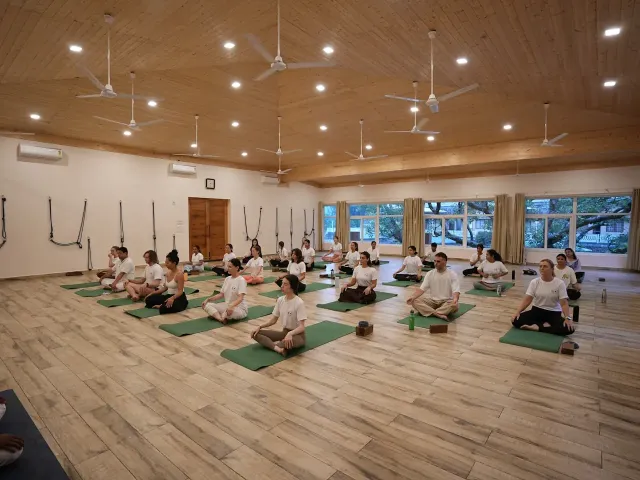
Stock photography throughout. The wellness stock photography canon, the silhouetted practitioner, the laughing woman in activewear, the overhead shot of a mat with candles, has been seen so many times that it registers as generic noise. Real photography of your actual space, your actual teachers, your actual students (with permission) is the single highest-ROI visual investment a studio can make.
Three Things That Quietly Kill the First Fold
Beyond the copy, three common elements sabotage the top of your homepage before a visitor has read a word.
Rotating image carousels. They slow load times, split your message across several images so each gets a fraction of the attention, and consistently underperform a single strong static photograph. Pick one image and commit to it.
Autoplay video backgrounds. A video that plays beautifully on your laptop over WiFi buffers endlessly on a phone over 4G, and load time is the metric that correlates most strongly with abandonment. The marginal aesthetic gain rarely justifies the cost.
Automatic pop-ups. A pop-up that appears before the visitor has read anything sends one message: we value our email list over your experience. Open rates on intrusive pop-ups are negligible; the irritation they create is not.
The One-Sentence Test
Read your current homepage headline. Now ask: would any of your ten closest competitors say the exact same thing?
If yes, it is not a headline, it is filler. It occupies space without creating recognition, without filtering for the right visitor, without building any advantage. The studios that win are the ones whose homepages feel unmistakably like them, specific enough to attract the right clients and distinct enough to be remembered.
Building that kind of homepage is not complicated. It requires clarity about who you serve, honesty about what you offer, and the discipline to remove everything that doesn't help a visitor decide to book.
At GladeForm, the homepage is where we start. Not because it is the most visible page (it is) but because every other page on your site either benefits or suffers from the job the homepage does. If you want to understand what a conversion-focused yoga studio website looks like end-to-end, our yoga studio web design page covers the full picture. Start with an audit if you're not sure yours is doing its job.

Founder & Lead Engineer, GladeForm
Palash builds high-converting digital environments exclusively for wellness practitioners. Before GladeForm, he spent years engineering digital products across industries — and kept returning to the same problem: the gap between how talented a practitioner was and how they appeared online. Learn more →